Be sure to check out our FANTASTIC 1st grade work in the 100 hallway (take a right at the main office)
Sunday, October 13, 2013
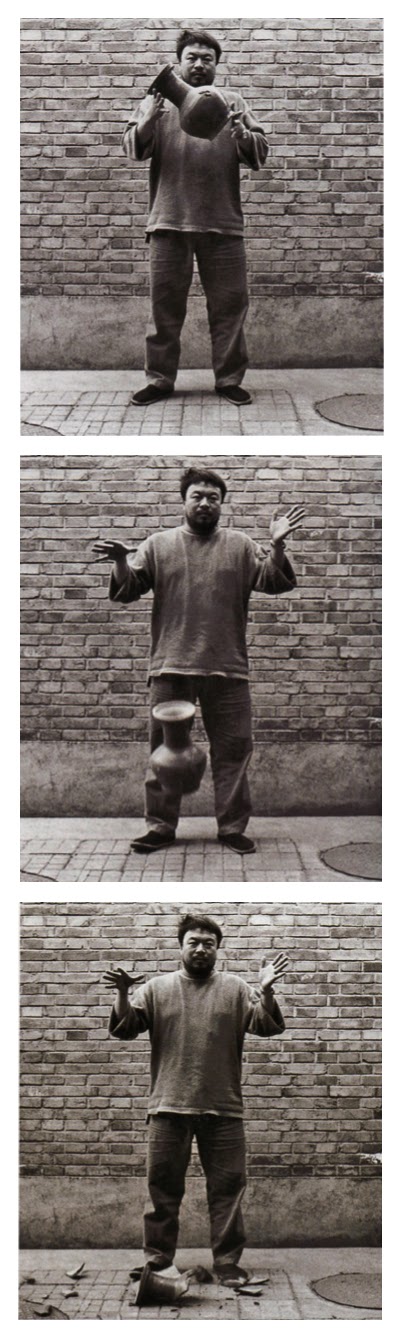
"Dropping a Han Dynasty Urn" by Ai Weiwei
Must art always be constructive (meaning to make something) OR can it sometimes also be destructive (meaning to destroy something)? Is one more expressive than the other? What might it mean to destroy an artifact others have said is an "important" part of your cultural heritage? Are there any things in history museums you would rather see smashed at your feet than looked at behind glass?
Controversial and highly political Chinese artist Ai Weiwei challenges his identity as a Chinese citizen and the power of today's anti-free speech Chinese government by smashing a very old and very valuable piece of Chinese history. What might the gesture/action mean? Can you think of an expressive action you could do to defy the people of power in your life (parents, teachers, government, etc.)?
Is the VALUE of art all in the name of the artist who made it? Do art collectors buy what they like or what is worth a lot of money to someone else?
Famous British Street Artist Banksy (who has managed to keep his identity a secret despite his fame) pulled off the ultimate prank on tourists and art collectors today. The artist set up a booth of original artwork (each valued in the $1,000's) near New York City's Central Park that was designed to look like the many knock-off booths found throughout the city. Despite the true value of the work, the booth and the old man working it (NOT Banksy) only managed to sell a few paintings. While this is not an endorsement to buy every cheap knock-off you see, remember that things are not always as they appear!
Wednesday, October 9, 2013
How might your understanding of the world be different if you were without one or more of your senses? How might you imagine the sun or stars if you could not see them? Could you "imagine" at all if you were born blind and have no idea what color or vision is? Be grateful for the senses you have but challenge yourself to "see" the world with more than just your eyes.
THAUMATROPE: an antique household toy which combines two images on opposite sides of a coin/disc by spinning the object rapidly at its axis
PHENAKISTOSCOPE: an antique household toy which features an object/figure changing little by little from one image to the next around the circumference of a disc. The disc is then spun and viewed through a special viewing window.
ZOETROPE: an antique household toy which features an object/figure changing little by little from one image to the next around the inner wall of a cylinder. The cylinder is then spun and the images viewed through slits in the sides.
PRAXINOSCOPE: an antique household toy which features an object/figure changing little
by little from one image to the next around the inner wall of a
cylinder. The cylinder is then spun and the images viewed reflected against several mirrors on the inside.
One of the earliest examples of modern hand-drawn cartooning dating back to 1914.
Walt Disney himself explains the technology that goes into his cartoons
Terry Gilliam of the famous British comedy group Monty Python makes animations using cut and altered photographs
William Kentridge makes animations by drawing and erasing charcoal drawings - each scene/shot being done on one constantly changing piece of paper
Even familiar hand-drawn characters can be re-imagined with the technology of today. When the Simpsons ventured into the world of CGI (Computer Generated Imagery) in 1995 it was considered groundbreaking. Many, many movies and shows use CGI today in a way that is indistinguishable from real life.
What kind of animation most appeals to you? Why? Which do you think would be the "hardest" to do? the "easiest"?