Wednesday, February 5, 2014

**DON'T TRY THIS AT HOME**

Some of the best results in art happen when we as artist give up some creative control and let nature and time decide what our art will become. See some of these terrific, unpredictable works of art below...

 
**NOTE: The fire ants killed in this process are a dangerous invasive species and would need to be killed one way or another - the normal ants we have here are no danger to anyone and an important part of our ecosystem.


Some "painters" (above: Italian artist Salvatore Raimondo) rely on simply submerging their canvas into waters rich in minerals, bacteria, etc. to create abstract works of art

 
Some "drawers" (above: UK artist Tim Knowles) allow the wind swept branches of a tree to hold their pencils and make their marks - while the results may not look like "anything", the drawing represents the passage of time in a totally unique way

How might you use a natural process to make an unpredictable work of abstract art? Think about your surroundings and how they change according to the time or day or season.


Food for thought from famous street (graffiti) artist Banksy...

"Outside is where art should live, among us, and rather than street art being a fad, maybe it’s the last 1,000 years of art history are a blip, when art came inside in service of the church and institutions.
But art’s rightful place is on the cave-walls of our communities, where it can act as a ‘public service’: provoke debate, voice concerns, forge identities.
The world we live in today is run by, visually at least, traffic signs, billboards, and planning committees. Is that it? Don’t we want to live in a world made of art, not just decorated by it?"
 
Will you continue to allow museums, galleries, and advertisers to "own" the art that defines our generation or will you do something to take it back?


Friday, December 13, 2013


GRADES 6-8: CHECK OUT SOME OF THE FANTASTIC CLASSES OFFERED BY THE ART INSTITUTE OF CHICAGO - Be prepared for high school art programs and spend some quality time with the many masterpieces of the Institute.

http://www.saic.edu/cs/msp/summercamps/

**Tuition is affordable for all students thanks to low prices and financial assistance!**


Sunday, November 17, 2013

HELP LEE SCHOOL GET A 3-D PRINTER 
For learning valuable artistic/technological solutions to the fabrication and manufacturing jobs of today and tomorrow. The MakerBot Replicator 2 3-D printer allows students to design and print any small-scale form out of plastic. Lee's students deserve to keep up with the most advanced technology available.

 Donate to our DonorsChoose page today to help us reach our goal. Please use the promo code "INSPIRE" at checkout to have your donation matched by DonorsChoose. Even the smallest donation helps!
THANK YOU!!!


Tuesday, November 5, 2013

WE HAVE A WINNER!!! The results of the school-wide vote were SO close that we had to combine some of the best aspects of the top lions into one hybrid design. Our 7th grade contributors were Jesus Contreras, Lorenzo Rivera, Itzely Candelario, Sebastian Osorio, Julian Fernandez, and Crystal Andrade. The font that had the most votes was from 8th grader Sergio Matias. Shirts will be available in a variety of colors, sizes, and styles. Thank you to everyone who voted and submitted entries!


The quality of a museum is not in its name or size according to New York City's Museum (yes, this museum is called just that). Built in an old elevator shaft in one of NYC's many alley ways, Museum is not just the smallest museum in the world it's also one of the strangest. The goal of the museum's founders is/was not to collect or showcase things that are already famous or significant, but instead to show stuff that represents what life is like right now - no matter how ordinary or insignificant. The idea is that something as simple as fake plastic puke or old potato chip bags can tell a lot about people. What do you think of this idea? Would people know what you were like if your bedroom was opened up to the public like a museum?
Photorealistic painter Robin Eley makes incredibly life-like pictures of people distorted by the wrinkles and folds of transparent plastic sheets/bags. In this progress video of his 2011 work Plastic you can see that his strategy is to simply paint every change in value (the lights, darks, and mid-tones) no matter how small they might seem. Every highlight and every shadow make their own unique shape and like pieces of a puzzle or the sections in a paint-by-numbers they come together to make a clear image. What might be the biggest obstacle to you painting in this way? (Mixing the right tones? Seeing the right highlight and shadow shapes? Making all the shapes fit together correctly?) It is only through practice that we learn to truly SEE. 

Monday, October 28, 2013

Professional product designers the Bressler Group started with the question "What if we started from scratch with all the unique United States state flags to make them have a matching color scheme and simpler overall design?" The resulting flags included a transformation of our own likeable state flag from
THIS:

to THIS:

In the case of Illinois's flag do you believe this was an improvement? Why or why not? Why/how might Americans benefit from having more unity between states?

For more information and short, thoughtful explanations for each transformation please visit: http://accelerator.bresslergroup.com/2013/08/united-we-stand/


While the appeal of making your mark in public places is undeniable and understandable, artists of all ages should ALWAYS remember to be careful when experimenting with art forms near or outside the boundaries of the law. Graffiti and street art have become more popular and well respected in the art community in recent years and - while I don't encourage vandalism - I DO encourage students to experiment with temporary street art such as reverse graffiti, yarn bombing, wheat paste, etc.

Canadian artist Dorota Pankowska reappropriates corporate logos "tagging" them using the products they represent (i.e. French's made out of mustard or Skippy made out of peanut butter). While the art is obviously temporary and washable, the art still makes the viewer think and re-imagine the products we use/eat/encounter everyday.


The New America from Nando Costa on Vimeo.

Stop-motion animation is not just reserved for drawings and cut paper - artists/filmmakers are constantly challenging and reinventing what are "acceptable" materials to use for the art form. In this example EVERY FRAME (24 frames per second) is a unique piece of laser engraved wood with a unique image. Pay attention to the constantly changing wood grain in each shot for a telling hint of the process. What other materials might be interesting to experiment with? Would a non-drawing process be harder or easier?

Tuesday, October 15, 2013


Be sure to check out our FANTASTIC 1st grade work in the 100 hallway (take a right at the main office)


Sunday, October 13, 2013

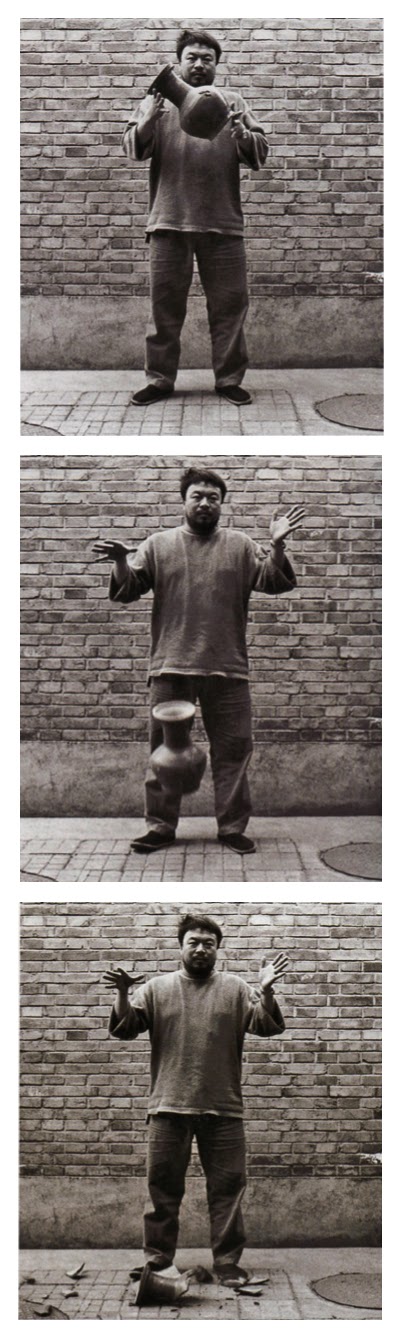
"Dropping a Han Dynasty Urn" by Ai Weiwei

Must art always be constructive (meaning to make something) OR can it sometimes also be destructive (meaning to destroy something)? Is one more expressive than the other? What might it mean to destroy an artifact others have said is an "important" part of your cultural heritage? Are there any things in history museums you would rather see smashed at your feet than looked at behind glass?

Controversial and highly political Chinese artist Ai Weiwei challenges his identity as a Chinese citizen and the power of today's anti-free speech Chinese government by smashing a very old and very valuable piece of Chinese history. What might the gesture/action mean? Can you think of an expressive action you could do to defy the people of power in your life (parents, teachers, government, etc.)?

Is the VALUE of art all in the name of the artist who made it? Do art collectors buy what they like or what is worth a lot of money to someone else?

Famous British Street Artist Banksy (who has managed to keep his identity a secret despite his fame) pulled off the ultimate prank on tourists and art collectors today. The artist set up a booth of original artwork (each valued in the $1,000's) near New York City's Central Park that was designed to look like the many knock-off booths found throughout the city. Despite the true value of the work, the booth and the old man working it (NOT Banksy) only managed to sell a few paintings. While this is not an endorsement to buy every cheap knock-off you see, remember that things are not always as they appear!